 EN

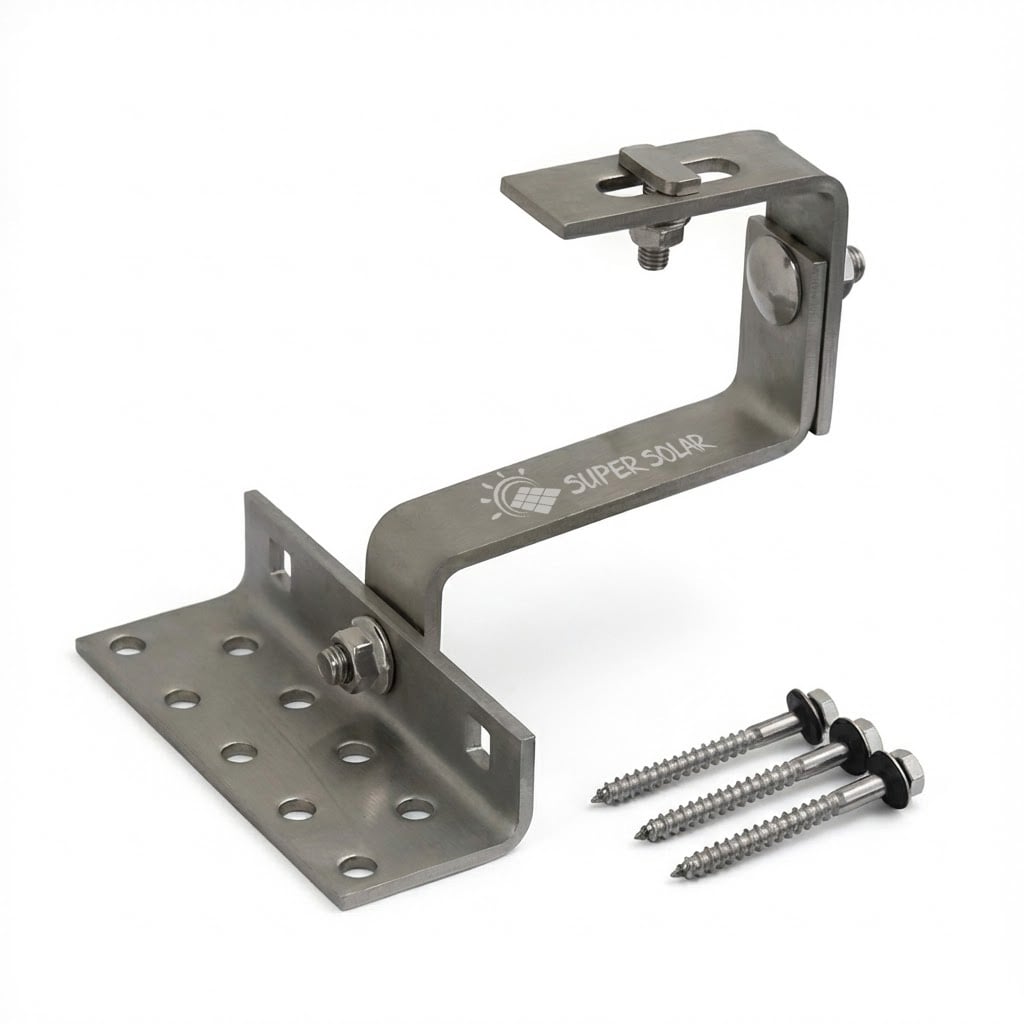

Every rooftop photovoltaic array is only as reliable as the point where it touches the building. On a tiled roof, that point is the roof hook. An adjustable roof hook for pv system sits between the tile covering and the timber rafter, and it carries the entire load path of the array: module frame to clamp, clamp to mounting rail, rail to hook, hook to structure. When that chain is specified well, the installation is fast, the roof stays watertight, and the array stays aligned for decades. When it is specified poorly, installers compensate on site with packers, cut tiles and improvised sealing, and the project carries a permanent risk of leaks and loose rails.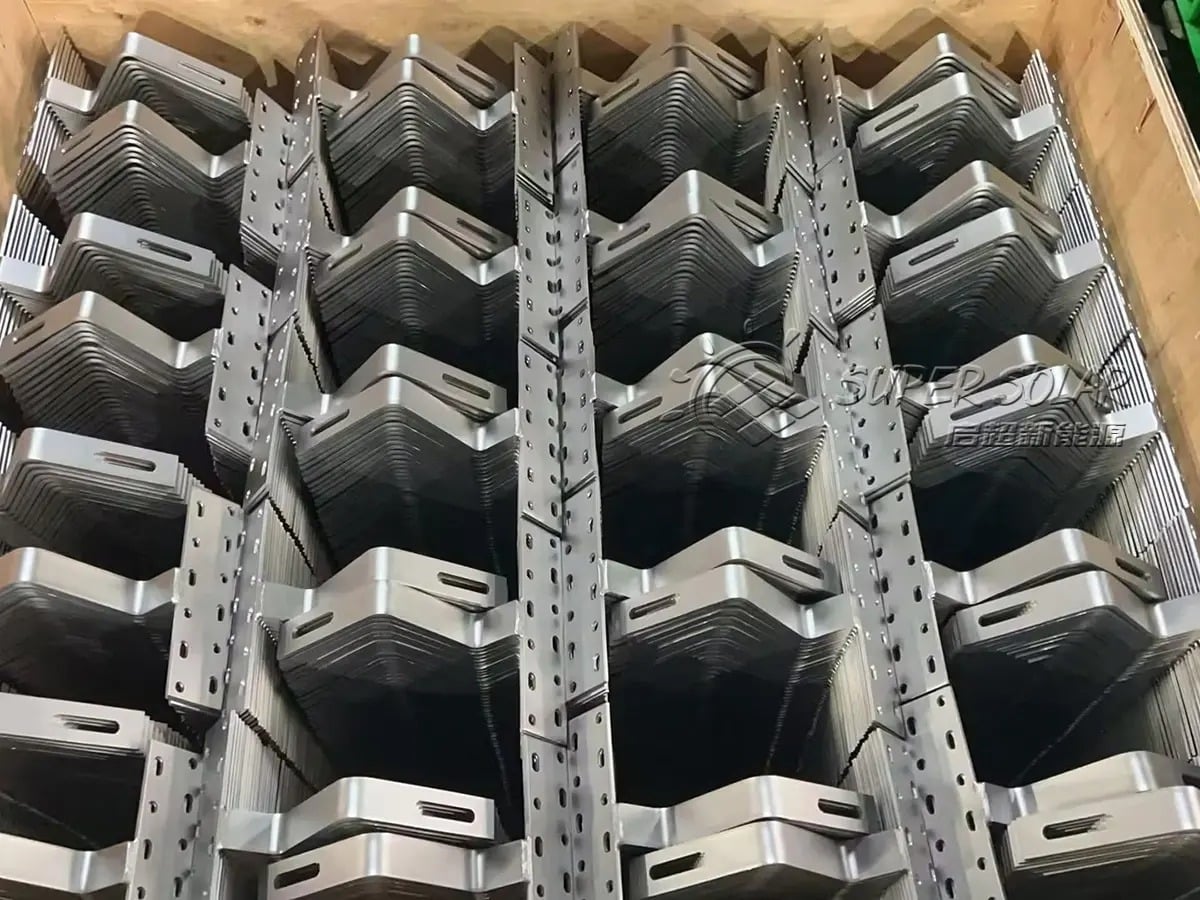
The problem is that tile roofs are not uniform. Tile thickness varies between production batches, batten lines drift across a long roof plane, older rafters sag, and the tile profile itself may be flat, Roman, Spanish or curved within the same building. A fixed hook has exactly one height and one geometry, so the installer either accepts the mismatch or invents a fix. That is the practical reason adjustability has become standard on serious tile roof projects rather than a premium extra. It is also why procurement teams increasingly ask for an adjustable roof hook for pv system by drawing number instead of by description alone, because two hooks that look identical in a photo can behave very differently once tile depth, rafter spacing and uplift loads are applied.
Understanding the component in three dimensions is the fastest route to a sound specification. Vertically, the hook must clear the tile covering and still land flat on the rafter. Horizontally, it must be positioned to suit real rafter centres rather than an idealised grid. Laterally, it must hold the rail at a consistent height so the panels sit in one plane. Get those three requirements clear before comparing suppliers, and the rest of the selection process becomes a short list of documented, verifiable checks. The sections below work through hook types, roof compatibility, materials and the engineering boundaries that a supplier should be able to document for your project.
Roof hooks are usually grouped by how they adjust, because that single characteristic determines which site problems the hook can absorb. A supplier who can explain the adjustment range and the intended failure mode of each family is generally a supplier who has actually installed them.
Vertical adjustment is the most requested feature on tile roofs. The hook body is designed so the upper section can be raised or lowered relative to the section fixed to the rafter, which allows the installer to match the finished tile surface without cutting tiles or stacking washers. On a concrete tile roof, tile thickness can vary noticeably between pallets, and on refurbishment projects the covering may not be the same product that was originally laid. A hook with usable vertical travel lets one part number serve the whole roof, which reduces both the risk of cracking tiles during installation and the number of line items the warehouse has to stock. The range of adjustment should be quoted in millimetres against a defined tile profile, not described as simply adjustable, because the useful comparison between two suppliers is the travel available in the direction the roof actually varies. For most tiled projects this single number decides whether one adjustable roof hook for pv system can serve the whole roof or whether two variants must be kept in stock for different tile depths.
Horizontal adjustment addresses the distance between the rail position and the rafter centre. Where rafters are irregular, or where the module layout does not line up neatly with the structural grid, a slotted or offset hook allows the rail to sit where the array needs it while the anchor remains centred on timber. This matters most on wide arrays with long rails, because a small lateral error at every hook compounds into a visibly wavy rail line across the roof. Lateral adjustment also helps when a hook has to avoid an obstruction such as a vent or a roof window frame without moving the whole rail run.
Fixed hooks are still the right answer on new-build roofs with consistent tiles, regular rafters and a single known tile specification. They are cheaper and there is nothing to set. Adjustable hooks make sense where any of those certainties is missing, and two-piece designs go further by separating the rafter bracket from the rail bracket, which can simplify retrofits and make replacement easier without disturbing the covering. Mixed arrays are common in practice: fixed hooks across the clean field of the roof and adjustable hooks around edges, ridges, penetrations and valleys, where geometry is least predictable and wind uplift is usually highest. Where a project is specified that way, the adjustable roof hook for pv system is doing the heaviest structural work in the array at precisely the points where a failure would be most damaging.
Tile geometry is regional. What works on a Spanish tile roof in one market may not fit the interlocking profile used a few hundred kilometres away, and local installation standards may specify how the hook must be anchored and how many fixings are required. A manufacturer with in-house engineering can produce custom hook geometry based on the tile shape, the rafter spacing and the applicable regional standard, and can supply the corresponding drawings for approval. For distributors, this is also the point where OEM and ODM become relevant, because a custom hook geometry can be branded and packaged as part of a private-label range. Super Solar manufactures its solar roof hooks in stainless steel with both fixed and adjustable configurations, and supports custom hook design development against tile shape and rafter spacing.
Compatibility is not a marketing statement, it is a physical relationship between a hook profile and a covering. The checklist below separates the cases that genuinely accept roof hooks from the cases where a different attachment family should be used instead.
Clay and concrete tiles are the classic roof hook application. The hook passes between tiles or through a dressed tile and anchors to the rafter beneath, transferring load to the structure while the tile itself carries almost nothing. Flat and low-profile interlocking tiles are the simplest case because the hook can pass through a small dressed gap. Higher-profile curved tiles require a taller hook body or a longer vertical adjustment range so the rail clears the cover and stays in plane. The key compatibility questions are the tile pitch, the tile thickness, the rafter spacing and the ability to reinstate the tile and flashing after installation without visible damage.
Roman and Spanish profiles are heavier and often laid to a pronounced curve, so the hook must be shaped to sit within the trough rather than on the crest. Flat tiles allow a simpler geometry but are more prone to cracking if the hook is forced. Slate is a different conversation again: the covering is thin, the fixing pattern is tight and the material splits if it is drilled carelessly, so hook selection usually involves a specific slate-compatible profile and a strict reinstatement method. A supplier working regularly across these covering types should be able to state which profiles a given hook is designed for rather than claiming universal tile compatibility.
Roof hooks should not be forced onto every roof. Standing seam metal roofs are normally served by non-penetrating seam clamps that grip the seam without drilling, which protects the roof warranty and the waterproofing layer. Trapezoidal and corrugated metal sheets usually take direct-fix brackets, mini rails or clamp arrangements rather than hooks, because the sheet itself is the structural interface and the geometry is completely different. Flat membrane roofs typically use ballasted or mechanically fixed systems with tilt frames. Recognising this boundary early prevents the most expensive specification error in rooftop PV: treating one attachment family as universally applicable. The relationship between these component families is summarised in the overview of solar mounting system components.
Compatibility also has a structural dimension. The hook transfers wind uplift and snow load into the rafter, so the rafter itself becomes part of the assessment. Timber condition, rafter spacing, span and the number of fixings per hook all affect whether the assembly is adequate. On uplift-critical zones such as ridges, corners and edges, hook spacing is typically tighter than in the field of the array. A supplier that provides wind and snow load calculations against the project's own criteria, rather than quoting a single generic figure, is giving you something you can actually submit for approval. Super Solar provides project-specific load calculations and can align designs with EN, AS/NZS and other international frameworks, which keeps the compatibility discussion anchored in engineering rather than in catalogue photos.
Specification notes that stop at "stainless steel" leave the two most consequential variables undefined: which grade, and what the assembly is actually rated to do.
Roof hooks are commonly produced in SUS304 or SUS316 stainless steel, with matching stainless fasteners. Inland and sheltered sites are usually well served by SUS304. Coastal sites, high-humidity regions and industrial atmospheres with chlorides or pollutants are better served by SUS316, because molybdenum content improves resistance to pitting and crevice corrosion. The distinction matters because the hook is often the most exposed component in the array, sitting under a tile where moisture lingers and ventilation is poor. Dissimilar metal contact should also be controlled so the hook does not accelerate corrosion of an adjacent component through galvanic action.
An adjustable hook is still a load-rated component, and adjustability does not remove the need for a defined capacity. Wind uplift governs roof arrays in most markets, and the critical pressure coefficients usually occur at edges, corners and ridges rather than mid-field. Snow load acts in the opposite direction and can govern in cold climates, particularly where snow accumulates against a ridge or behind a parapet. The design boundary is the combination of hook capacity, fixing capacity into the rafter, and the rafter's own ability to take the reaction. Where any element is unknown, the safe path is a project-specific calculation rather than a default spacing rule.
Every hook creates a penetration in the covering, and the quality of the reinstatement determines whether the roof leaks in year five. The waterproofing strategy normally combines correct hook geometry so water cannot track along the stem, a flashing or dressed tile arrangement that laps in the direction of water flow, and where appropriate a sealing element such as a butyl or EPDM interface. The sequence matters as much as the material, because a perfectly good flashing installed with the wrong lap direction is still a leak. Adjustable hooks help here indirectly, since less cutting and fewer packed tiles means fewer places where water can track.
Ask for the material grade and surface condition, the adjustment range with its reference profile, the rated load directions, the fixing requirement into the rafter, the recommended sealing arrangement, and a drawing that shows the assembled stack-up with the tile reinstated. Ask also for the applicable standard or test basis. A response that contains these six items in writing is a strong signal that the supplier manufactures and engineers the part rather than merely trading it. The same six items are also what a designer needs in order to state, with evidence, that the chosen adjustable roof hook for pv system suits the roof rather than merely fitting it.
The final stage is administration as much as engineering. Complete the specification first, then let commercial terms follow.
Request a project drawing showing hook positions across the roof, not just a component datasheet. The drawing should reconcile hook spacing with the rail layout, the module layout and the structural grid, and should identify where spacing tightens in edge and corner zones. Where the project needs an engineering submission, the corresponding load calculations should reference the same design inputs. For a new hook geometry or a new tile profile, a physical sample and ideally a pilot installation on a representative roof section will resolve more uncertainty than any further discussion.
Once a hook is approved, the practical risk shifts to consistency. Extrusion and stamping tolerances, hole positions and material grade should be controlled batch to batch, because a hook that varies in height by a few millimetres will produce a rail line that is visibly out of plane across a large array. For distributors and multi-year programmes, it is worth confirming how long the geometry will remain in production and how a replacement order will be matched to the original specification. Material test reports and dimensional checks per batch are the usual evidence.
Confirm the finish and packaging specification, whether private labelling is available, the standard and custom lead times, and whether stock items can be shipped quickly for urgent phases. Super Solar keeps standard hook models available for shipment within a short window and typically produces custom configurations in a longer cycle depending on order size, and it supplies drawings, samples and factory pricing on request so that commercial and technical approvals can proceed together. Samples are also available for testing or design matching before a bulk order is released.
Adjustability earns its cost when any of the underlying dimensions is uncertain or variable. If the roof is a new build with a single confirmed tile product, regular rafter spacing and no refurbishment history, a fixed hook can be entirely appropriate. If tile thickness varies, rafters are irregular, the covering is being reused or replaced, or the array extends around ridges, valleys and penetrations, an adjustable roof hook for pv system will usually pay for itself in reduced tile cutting, fewer callbacks and a flatter rail plane.
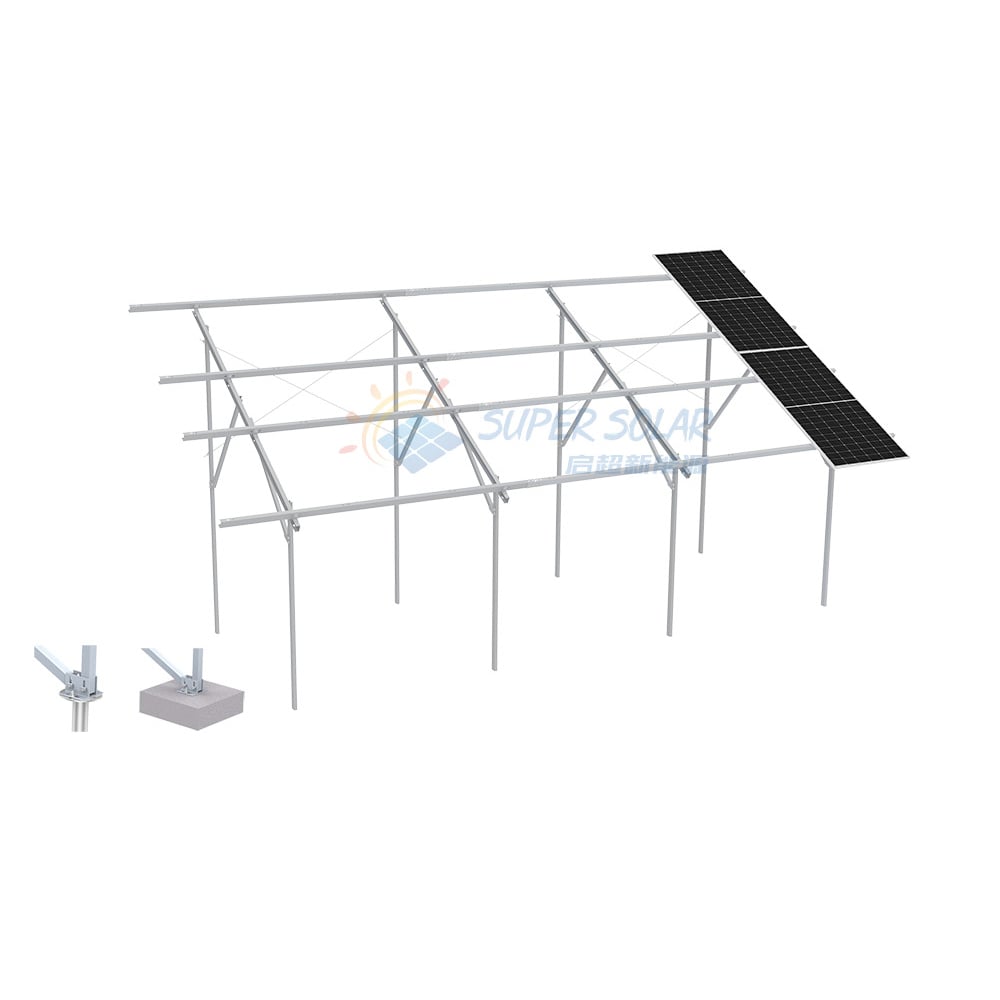
No single hook is universally correct, and treating one part as a universal solution is a common cause of failed installations. Tile and slate roofs use hook-type attachments that anchor to the rafter, with geometry matched to the covering profile. Standing seam metal roofs are normally installed with non-penetrating seam clamps, while trapezoidal and corrugated sheets use direct-fix brackets, mini rails or roof clamps. Each family has its own load path and its own waterproofing logic, so the attachment should always be selected from the roof structure outwards.
Send the roof covering type and profile, tile thickness and pitch, rafter material and centre spacing, the mounted area and its position on the building, the module dimensions and layout, the design wind and snow loads with the governing standard, the required material grade if the site is coastal, and any local code or approval requirements. Include photographs of a typical roof section and of any difficult detail such as a ridge, valley or existing penetration. With this input a supplier can return a specific drawing, an adjustment range and a load statement rather than a generic catalogue entry.
Assess it as a system rather than as a part. Confirm that water cannot track along the hook stem into the structure, that flashing and dressed tiles lap in the direction of flow, that the sealing element is compatible with the covering material and with expected temperatures, and that the reinstatement method is repeatable by an average installer on site. Ask to see the reinstatement detail drawing for each distinct roof condition on the project, and check that the design still works after the tiles are replaced, because the interface between tile, hook and flashing is where most rooftop leaks begin.
 Hot News
2025-11-03
2025-10-22
2025-01-24
2024-06-12
2024-06-12